
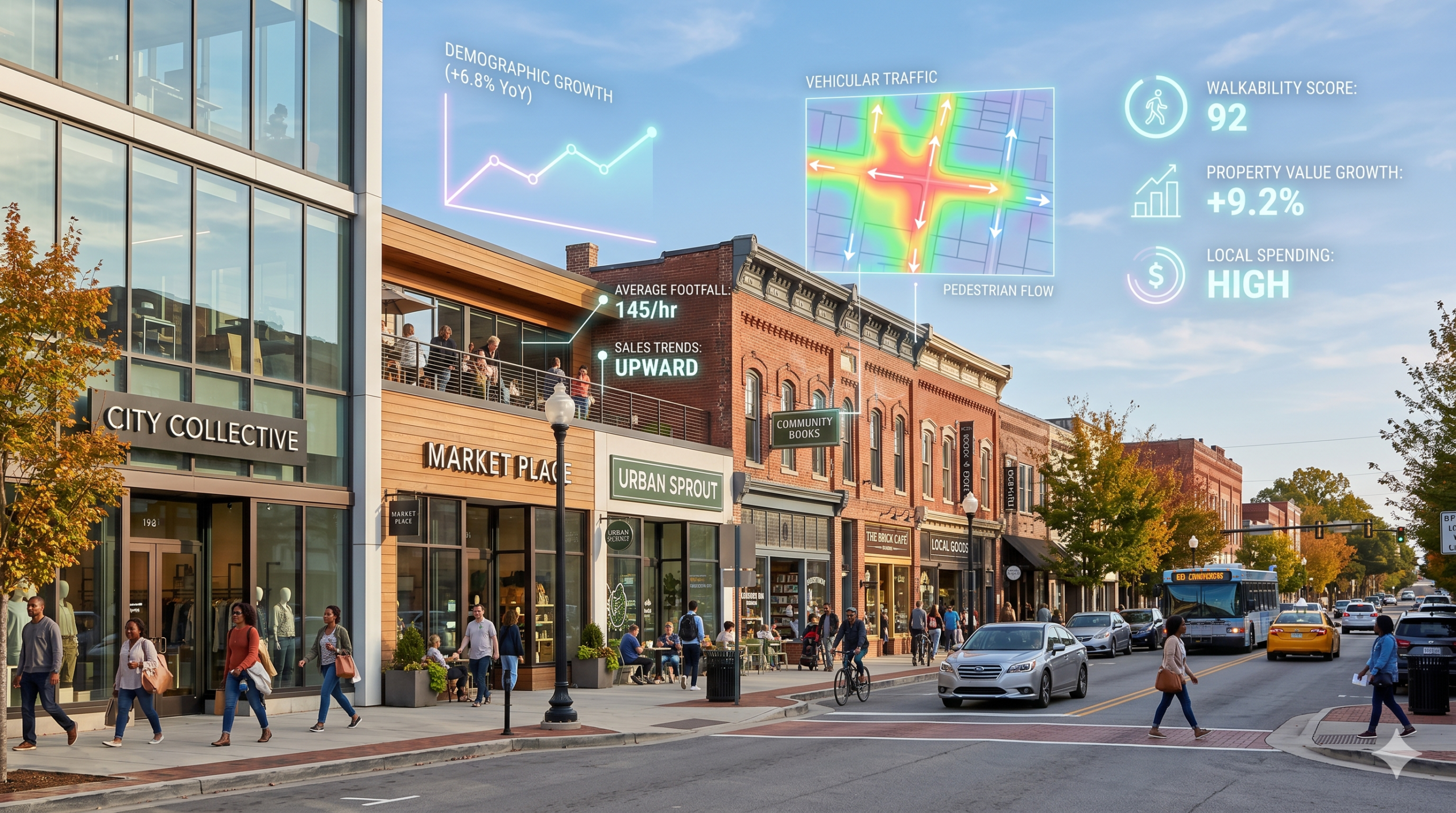
Every commercial real estate investor and entrepreneur is familiar with the classic “Location, Location, Location” cliché. However, looking at a neighborhood through a static lens only tells you what a site is worth today. To build sustainable wealth and secure long-term commercial success, you must transform your perspective from static real estate placement to dynamic economic forecasting. The real skill lies in learning how to analyze a neighborhood for business value years before that value reaches its peak premium price.
Settling into an already highly mature business district usually means paying sky-high square-foot premiums that squeeze your operating margins. Conversely, choosing an area based solely on a “gut feeling” can lead to catastrophic capital losses. To identify true under-market economic growth pockets, you need a methodical, data-driven strategy. Here is your actionable, comprehensive guide to evaluating micro-markets for future commercial growth.
1. Demographic Momentum: Mapping the Human Factor
A business cannot survive without consumers or a qualified labor pool. Therefore, the foundational step to analyze a neighborhood for business is measuring demographic velocity—not just looking at current census counts, but evaluating direction and speed of population shifts.
Analyzing Disposable Income Patterns and Population Shifts
Look at the rolling three-year trends for Median Household Income (MHI). A stagnant or decreasing income trend line signals an area where consumer pricing power is eroding. Conversely, a steady annual rise of 3% to 5% above the regional average indicates an influx of affluent consumers. Pay close attention to family sizes and employment distribution figures; an expanding pool of white-collar professional households historically correlates with a spike in local service-sector demand, from modern dental clinics to boutique fitness facilities.
Identifying Generational Flocking Patterns
Where are young professionals and young families moving when they get priced out of major downtown centers? These adjacent residential rings are primary terrain for future business value. When millennials or Gen Z start concentrating in a zip code, retail and service spending inevitably follows within an 18-to-24-month lag pattern.
2. Commercial Ecosystem: Assessing Competition and Synergy
No business property operates inside a vacuum. A micro-market’s current commercial mixture can either starve your enterprise or organically drive qualified consumers straight to your front door.
Complementary Foot Traffic and Anchor Tenants
Examine the proximity of “anchor” traffic drivers. While a national grocery store chain or a regional healthcare hub might seem like a competitor on paper, they are actually powerful engines that generate consistent, programmatic consumer habits. If your prospective site sits along the immediate morning transit paths or shares a block with these high-frequency destinations, your business naturally absorbs their residual foot traffic.
Pro Tip: Use municipal toolsets or digital mapping platforms to check average daily traffic (ADT) counts. An accelerating ADT curve over a multi-year timeline strongly proves a neighborhood is morphing into a major economic thoroughfare.
The Saturation Index vs. Unmet Local Demand
Conduct a thorough void analysis. If you want to open an upscale café, and there are already five artisanal roasters within a four-block radius, the market indicates a high saturation profile. However, if the neighborhood features rapid residential growth but lacks key community services—like physical therapy offices, childcare facilities, or pet care spaces—you have discovered an economic void with high intrinsic business value.
3. Infrastructural and Municipal Catalyst Identifiers
True macroeconomic appreciation is frequently triggered by public policy decisions and structural infrastructure adjustments. Local government archives hold the true crystal ball for smart site selectors.
Zoning Overhauls and Future Infrastructure Pipelines
Review city planning commission records for upcoming zoning changes. Areas transitioning from light industrial (M-1) to mixed-use commercial/residential (MU) are prime targets for future capital appreciation. Furthermore, track upcoming capital improvement projects: municipal park installations, light rail expansions, or highway interchange upgrades are reliable indicators of future localized growth cycles.
Accessibility, Walk Scores, and Micro-Mobility Integration
Affordability relies heavily on consumer access. A neighborhood featuring a low walkability footprint can still hold excellent value if it boasts clear vehicular access, easy left-turn positioning across dual-lane streets, and abundant parking ratios. For urban concepts, evaluate the proliferation of modern micro-mobility options like designated bike lanes and scooter share hubs, which structurally widen your physical consumer pull radius.
4. Boots-on-the-Ground Metrics: The Micro-Observations Lenders Look For
Data models are highly powerful, but they must be balanced by physical, direct site observation. When underwriters and commercial lenders audit a location, they look for micro-signals of neighborhood investment health:
- Scaffolding and Renovation Activity: Count how many older residential or commercial properties are undergoing active structural stabilization or modern facade improvements.
- Commercial Adaptive Reuse: Note instances of older warehouses or historic spaces being dynamically converted into trendy food halls, coworking spaces, or medical centers.
- Corporate Retail Commitments: Watch where corporate chains like Starbucks or CVS are breaking ground. These organizations deploy massive budgets for market research; if they choose to build, they have already validated the neighborhood’s long-term economic path.
Summary Checklist: Your Neighborhood Site Analysis Playbook
When you prepare to evaluate a prospective commercial space, ensure you have gathered data on this clear four-point profile:
- Three-year historical population and household income growth percentages.
- Proximity and walking/driving path access to regional daily-needs anchor tenants.
- Pending municipal zoning updates, public transportation expansions, or street widening initiatives.
- Current vacancy velocity trends within a 1.5-mile geographic radius of the property.
Conclusion: Capitalizing on Emerging Visual and Analytical Data
Learning how to analyze a neighborhood for business potential demands a balance of digital demographic research and raw, local physical observation. By tracking demographic trends, monitoring municipal zoning pipelines, and mapping out the local commercial ecosystem, you eliminate risky guesswork from your location strategy. Spotting these localized economic movements early allows you to lock in favorable long-term commercial terms before the wider market realizes the area’s true growth potential.