
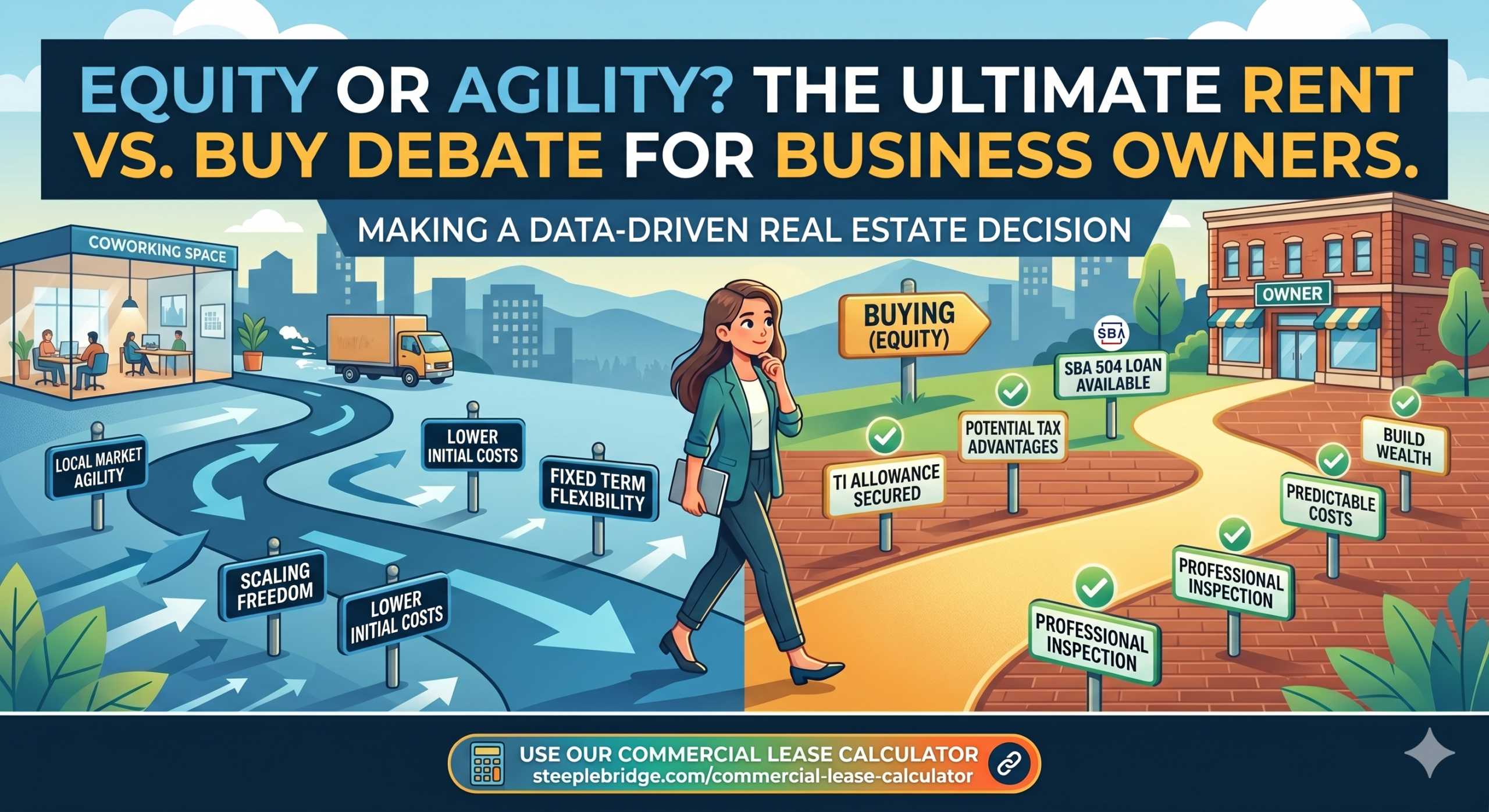
One of the most significant crossroads a business owner will ever face is deciding whether to continue paying a landlord or to become one. The decision to move from tenant to owner is often framed as a purely financial one, but it’s actually a strategic tug-of-war between equity and agility.
In this commercial rent vs buy analysis for small business, we will break down the true costs of both paths to help you decide which “home” fits your company’s future.
The Case for Ownership: Building Business Equity
For many, the idea of “throwing away money on rent” is a major pain point. Ownership transforms a monthly expense into a long-term asset.
Long-Term Wealth and Fixed Occupancy Costs
When you own your building, you are essentially paying yourself. Every mortgage payment increases your equity. Perhaps more importantly, you eliminate the risk of “rent shock.” In a hot market, a landlord might double your rent at the end of a term; when you own, your mortgage remains a predictable fixed cost.
Commercial Property Tax Advantages for Small Business Owners
The IRS offers several “gifts” to property owners. Through depreciation and interest deductions, you can significantly lower your taxable income. Additionally, the commercial property tax advantages for small business owners allow you to offset the costs of property ownership in ways a tenant simply cannot.
The Case for Leasing: Maintaining Operational Agility
While ownership builds wealth, leasing builds flexibility. For many growing companies, the ability to pivot is more valuable than a deed.
Why Startups Often Benefit from Leasing
When you lease, you aren’t tied to a specific square footage for the next 20 years. If your team doubles in size in 18 months, you can relocate relatively easily. Ownership can become an “anchor” if your business outgrows the space faster than expected.
Opportunity Cost of Buying Commercial Real Estate
The biggest downside to buying is the down payment. Moving $200,000 from your bank account to a building’s equity means that money is no longer available for inventory, R&D, or marketing. You must weigh the opportunity cost of buying commercial real estate against the potential ROI of reinvesting that cash into your core business operations.
The Financial Deep Dive: Loans and Leverage
If you decide to buy, you aren’t necessarily stuck with a traditional, high-down-payment bank loan.
Leveraging the SBA 504 Loan for Buying Business Property
The SBA 504 loan is a game-changer for small businesses. It allows you to purchase property with as little as 10% down, often with a below-market, fixed interest rate. This levels the playing field, making ownership accessible even for businesses that aren’t sitting on massive cash reserves.
Maintenance and Management: The Hidden Burden
Remember: when you own the building, you are the janitor, the roofer, and the plumber. You must account for the time and capital required for property management. If a pipe bursts at 2:00 AM, it’s your problem, not the landlord’s.
The Tipping Point: When is the Right Time to Buy?
Buying isn’t a badge of honor; it’s a tool. The right time to buy is usually when:
- Your space needs are stable: You know exactly how much room you’ll need for the next 7–10 years.
- Your cash flow is consistent: You can handle the mortgage and the maintenance without stressing your payroll.
- The market is right: The cost of the mortgage is comparable to (or lower than) local market rents.
Conclusion: Making a Data-Driven Real Estate Decision
Neither renting nor buying is inherently “better.” A tech startup that needs to double its staff every year should likely remain agile and lease. A dental practice or a specialized manufacturing plant with heavy equipment should likely seek the stability of ownership.
Before you make the leap, run the numbers. Use our dedicated tool to compare your current monthly lease costs against a potential mortgage and ownership expenses.
Ready to see the math? Check out our Commercial Lease Calculator to get a clear picture of your best financial move.