
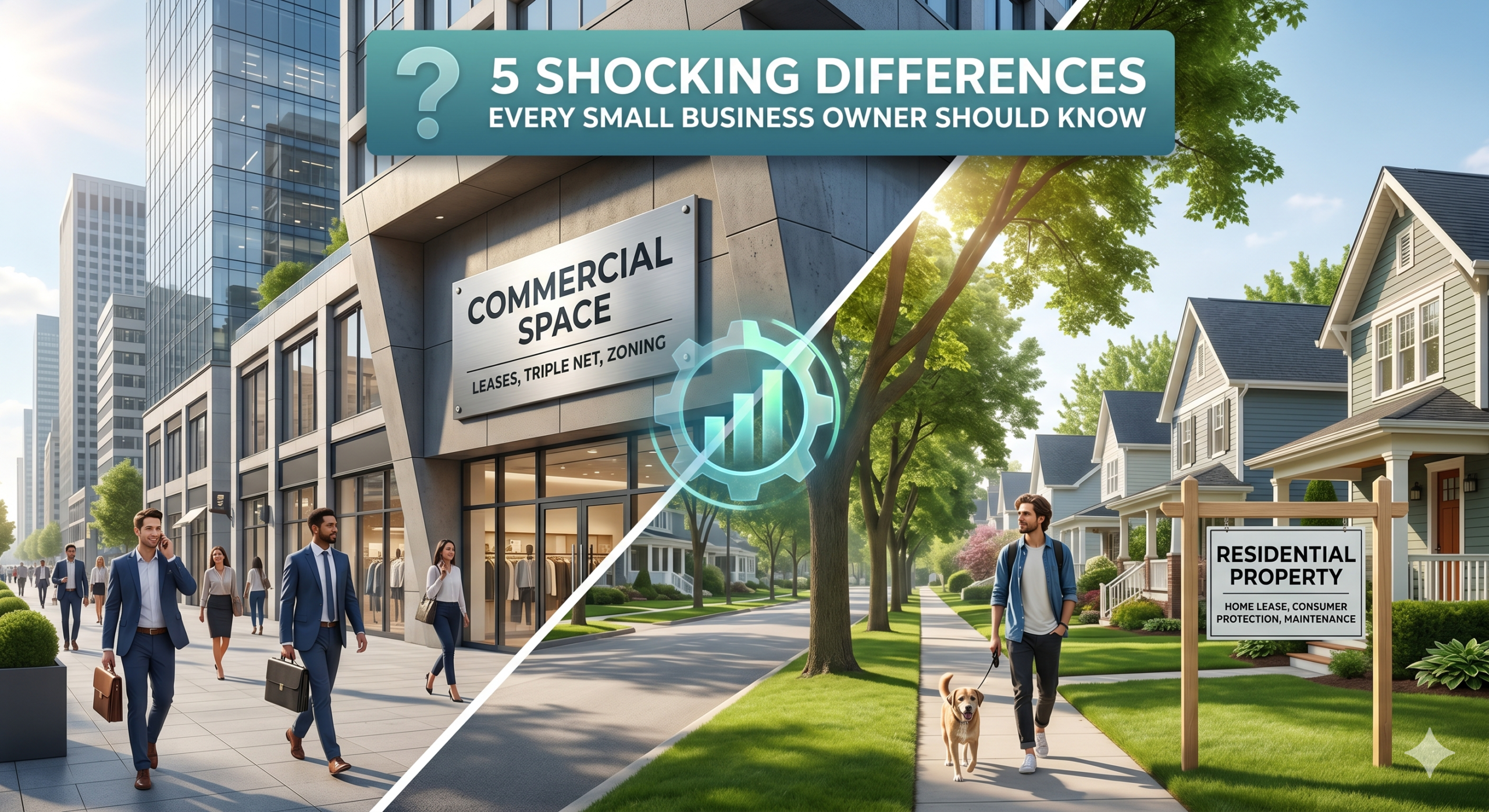
If you’ve ever rented an apartment or bought a home, you might feel like you have a solid handle on how real estate works. But for the small business owner stepping into the world of “Commercial,” the learning curve isn’t just steep—it’s often expensive.
The “real estate is real estate” myth is one of the quickest ways to drain a startup’s capital. When you move from a residential mindset to a commercial one, the rules of the game don’t just change; they are rewritten entirely.
Here are the five shocking differences you need to know before you sign on the dotted line.
Understanding the Commercial Lease vs. Residential Lease Framework
In the residential world, the law assumes the tenant is an individual who needs protection. In the commercial world, the law assumes you are a sophisticated business entity on equal footing with the landlord.
Why Consumer Protection Laws Don’t Apply to Your Business
Unlike residential rentals, which are governed by strict consumer protection and “habitability” laws, commercial leases are largely “buyer beware.” There are no standard grace periods for rent or automatic rights to repair unless they are explicitly written into your contract. If it isn’t in the lease, it doesn’t exist.
The Complexity of Triple Net (NNN) Leases
One of the biggest hidden costs of commercial real estate is the Triple Net Lease. In a residential setting, your rent usually covers taxes and insurance. In a commercial NNN lease, you pay your base rent plus your pro-rata share of the building’s property taxes, insurance, and common area maintenance (CAM). This can add 20% to 40% to your monthly overhead.
Maintenance Responsibilities in Commercial vs. Residential Properties
When a water heater breaks in an apartment, you call the landlord. When the HVAC system fails in a retail space, the landlord usually calls you.
From Lightbulbs to HVAC: Who Really Pays?
Most small business owners are shocked to find that they are responsible for everything “within the four walls.” This often includes expensive mechanical systems. Before signing, always negotiate a maintenance cap or ensure the HVAC has been recently serviced, otherwise, a $10,000 repair could hit your balance sheet in month three.
Navigating Small Business Guide to Commercial Zoning Laws
You found the perfect corner unit for your boutique bakery. The lighting is great, and the foot traffic is high. But there’s a catch: the zoning doesn’t allow for commercial ovens.
Why Your Location Might Be Illegal for Your Business Type
Residential zoning is straightforward—people live there. Commercial zoning is a maze of “Use Clauses.” Even if a space is “commercial,” it might be restricted to “office use only” or “dry retail.” Operating a business that violates local zoning or the landlord’s specific “Exclusive Use” clauses can lead to immediate eviction and heavy fines.
The Financial Reality of Commercial Real Estate for Startups
The barrier to entry for commercial property is significantly higher than for a family home.
Higher Down Payments and Stricter Lending Requirements
While you might buy a home with 3% or 5% down, commercial lenders typically require a 25% to 35% down payment. Lenders aren’t looking at your credit score alone; they are looking at your business’s debt-service coverage ratio (DSCR) and projected cash flow.
Longer Lease Terms and Lack of Flexibility
Residential leases are typically 12 months. Commercial landlords, however, want stability. You will likely be asked to sign a 5-to-10-year lease. For a startup, this is a massive commitment. If your business grows too fast—or fails—getting out of that lease can be nearly impossible without a “break clause” or a personal guarantee.
Conclusion: Making the Right Move for Your Company
Transitioning from residential to commercial real estate is a milestone for any small business, but it requires a total shift in strategy. The protections you are used to as a renter disappear, replaced by complex negotiations and significantly higher financial stakes.
The best ROI you can get during this process isn’t in the square footage—it’s in the due diligence. Never sign a commercial lease without a tenant-rep broker and a lawyer who can spot the “hidden” traps in the fine print.
Ready to take the leap? Consult with a commercial broker today to ensure your first business home is a foundation for growth, not a financial burden Click here.
Want help comparing Commercial Leases?
You can access our free Commercial Lease Calculator. The Calculator provides real insights into your actual monthly real estate cost and where you can utilize leverage to negotiate better leases.